A relational approach to researching regenerative agriculture
A conversation with Galina Kallio
Published 27 October 2025 in Educations
Photo: Risto Musta and NÄKYMÄ. Courtesy of NÄKYMÄ.
Interview, transcription and editing by
Denise Araouzou
In the Margins
An important question when it comes to how or where ecopedagogies may flourish and permeate our ways of thinking and being, is one of places. Conversations under the heading ‘In the Margins’ speak about places which exist outside institutional frameworks, on the ‘margins’ of our society, but which can be considered as pivotal in eliciting profound shifts of perspectives, values, sense of belonging, and relationships towards socio-ecological regenerative ways. What kind of places can we learn from and with? What kind of places (re)configure relations for more just and caring multispecies societies, and how can we become active with/in them?
During my residency at Saari Residence in the winter months of 2024, I met dramaturge Ilja Lehtinen, who was the guest artist of the residency at the time. Upon hearing about my research, he suggested I look into the work of Galina Kallio. So I began reading her work and her article Hope beyond Hope spoke directly to my questions on how to practice hope through cultivating – literally and metaphorically – relations with the land. Our conversation touched on senses, regenerative research methodologies, hope as action and how interspecies relations and land informs our perception of time and urgency.
Our conversation
Denise: Thank you Galina for finding the time to speak with me today. Your article ‘Hope beyond Hope’ (2023) really resonated with me. I’m in the process of moving from life in the city to a rural village where I plan to learn permaculture, tend the land and maybe set something up in the form of a community arts centre focused on the land, agroecology and ecopedagogy. These possibilities give me hope, and your article grounded them in many ways. So, I would love to speak about your research on that and some things in-between.
Galina: This article wasn’t something I planned, but it became inevitable not to write it. I started this project in 2019; it was titled Invisible Work in Regenerative Agriculture and I created a website for it to make some of the interviews available to everyone. At least three of them have been made in English, so perhaps you can listen to those. In 2019, as I explain in the article you just mentioned, I also began working at different, small-scale, regeneratively-oriented farms and it was an intense beginning of something I didn’t yet realise what it was.
Denise: How did your research about hope and hopelessness inform or change your life over the years?
Galina: My life started to change radically through this work and through these encounters. The field work showed me the learning and unlearning I had to do myself too, so my method this time round was a bit different than I had previously applied. I went in without any preformed agenda. In a way, I wanted to know what to ask before asking what I didn’t know. First, I wanted to understand what is important and meaningful for the people and for the more-than-human communities in these farms – they were my guides. This process that made me rethink my life. So we ended up buying this place and after three years we moved in. Another important process for me that started during this research was realising that I cannot continue living in the city anymore and leading the life I used to lead. While writing this article, I also realised that the academic way of doing — the way we are trained as researchers and the way we are expected to do our research — is extractive. Saying that out loud had a great impact on me and affected how I wish to express the research, how I write about it, and the way that I do the research. Ultimately this article became a crossroads for me. Since then I’ve been moving very consciously towards alternative ways of representing.
This means bringing other forms into the written form. For example, I have a poetic photo essay under review which is also a kind of intimate essay about encounters with life and death; particularly with animal death and dying at farms. I believe it’s a very telling, or very descriptive way of recounting a story, but it’s just another way of telling a story. I also find it’s a more respectful and more honest way of representing research than the one that is placed inside parameters defined not by the research, but by academic conventions.
The relational and practice-based approach has always been intrinsic in my research. It’s become more so though through this recent intensive ethnographic field work with farmers and small-scale farmers and with a particular attention to the more-than-human web of life. I mean focusing beyond solely human relations and considering our relations with the land, with the soil, with other animals, with microbes, with earthworms, with pollinators — with all living beings. I’ve only now started to realise, and thanks to these kinds of research settings, what ‘relationality’ actually means. How does it direct us towards a very different knowledge production than typical data gathering? Gathering data by treading lightly.
I don’t think I’m the typical scholar; I didn’t plan for this to happen. It happened organically because of the relationships I started to create for myself. It’s inevitable that it changed the way that I do research and the way that I perceive knowledge production. Even though I’ve always been critical of academic institutions, it wasn’t in a profound epistemological and methodological kind of way.
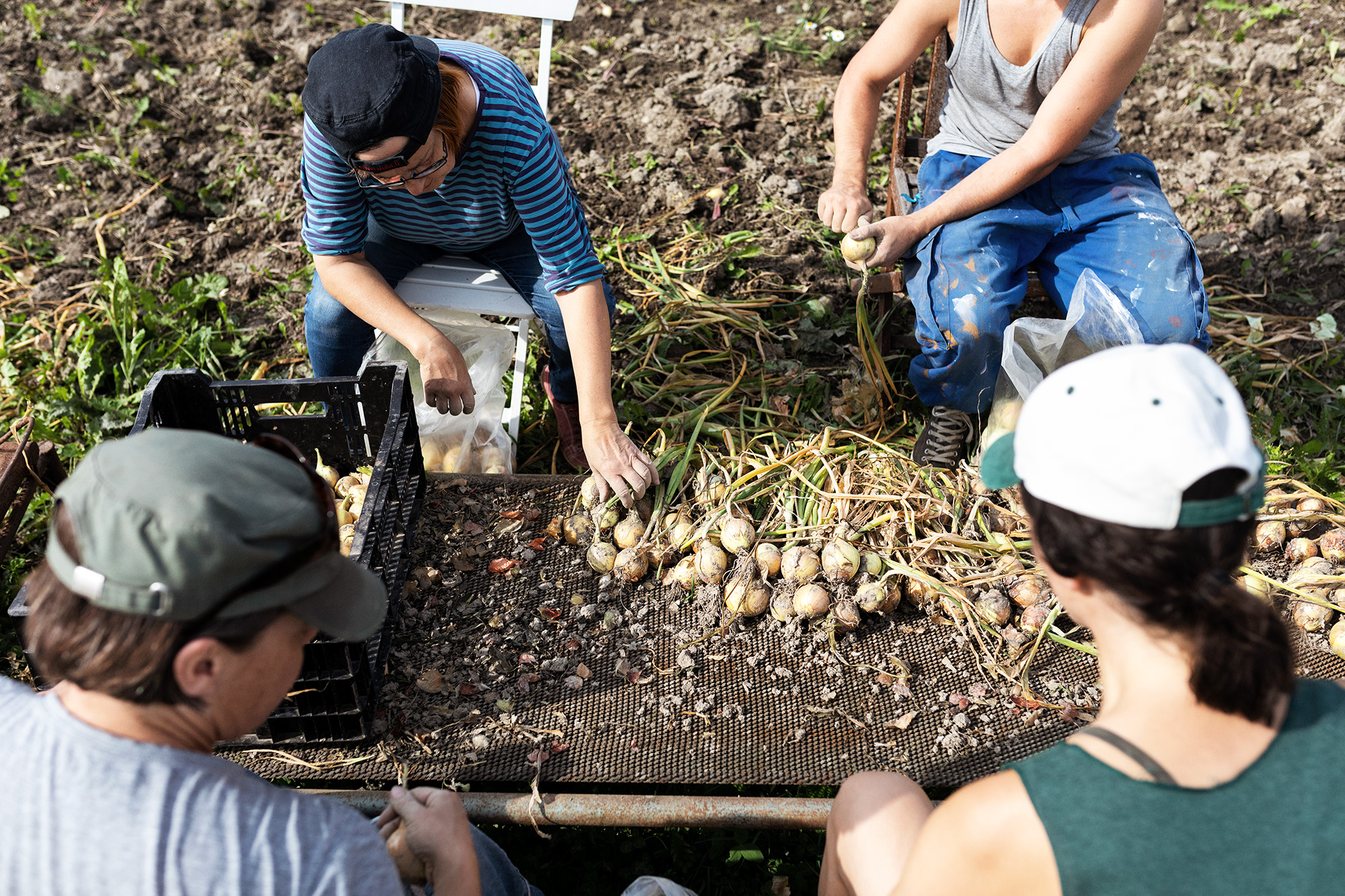
Photo by Risto Musta. Courtesy of NÄKYMÄ.
Denise: That came through while reading you work. What stood out to me is that you co-designed the semi-structured interviews with the farmers. As an art curator, I’ve always been interested in critical pedagogy and socially-engaged practices, so when I embarked on the journey to become a researcher, I was confronted with the same questions. To approach research from a posthumanist, decolonial and agential realist position I recognised that I had much less agency as an “individual” doing the research as I initially thought. It was incredibly liberating and humbling – I am telling stories with and thanks to other agencies – human and more-than-human. They helped me think through the research. I was wondering whether you had any companions – human and more-than-human – that guided you through the process of moving between hope and hopelessness?
Galina: Hm, that’s a good question. It’s easier to make conclusions based on something you can articulate and vocalise. I guess the paradox is that the less we verbalise things, the more we may feel the need to arrive to conclusions; even though conclusions are always made. Instead, nonverbal communication requires very intimate relationships and a lot of experience in order to draw any conclusions from it, right? It seems to me that this dynamic of hopelessness that is very visible in everyday life is probably more equal between humans and more-than-humans than we think. For instance, empathy can easily lead to feelings of hopelessness when you’re faced with such loss across habitats and species. But hope is so much more difficult to draw conclusions about. While writing the article I realised that what I’m finding important to say is that the way we have conceptualised and understood hope in our western cultures and societies is very detached from the reality, from the everyday life and from action. There is a huge disconnect – it almost feels immaterial somehow, right?
But from a relational and practice-based perspective, nothing is immaterial. Words are not immaterial, right? So then I started to realise that: of course hope is not immaterial. Even imagination is not immaterial, because it happens in your body. I think it’s a really good question to continue working with: if, and how, more-than-human communities or companions are helping us observe hope and hopelessness.
Denise: You mentioned in the article that hope is about learning to see and learning to notice.
Galina: Yeah, exactly. It’s materially-embodied. A set of skills, or a process of skills.
Denise: And senses. When I’m out walking my pace can be quite slow because I often stop to notice. And even if I don’t notice something immediately, I train myself to notice things and rely on my senses other than just sight. I feel like our senses are diminishing; from Long Covid that interferes with our sense of taste and smell, to toxic pollutants in the air interfering with our capacity to connect smells to our hippocampus, a part of the brain also responsible for navigating space and memories. Then there’s the sense of touch. Lately I’ve been really enjoying working with clay and earth and reading its colours and textures with my fingers. Moving through my senses has been really rewarding and grounding, so I’ve been wondering what kind of connection our senses have to our ability to cultivate a sense of hope. Speaking about pace, I’m aware that it can be a privilege in this day and age to have the time to live rurally for people whose livelihoods don’t actually depend on the land.
Galina: Yes. I didn’t have time to delve into the concept of time and temporality in this article, but I have an article in my drawer that I never published and it’s about rhythms and rhythmicity. It’s called ‘Practiced time as rhythms’. I still wonder whether I can find the time to write that piece because this connection of hope as action into time as a practical manifestation of our inter-being with the land is a very important and complex relation.
I realised while writing ‘Hope beyond hope’ that, what links hope as action to the land, to the concrete, land-based activities is exactly the living-in-time and through time; which is to say that farmers make a commitment to live in eternal time. In the discussion section I touch on intergenerational farming landscapes (Ingold, 1993), but this perspective really deserves to be an article of its own.
Their commitment is eternal. And yet, even one season, which is a short period of time calculated in linear time, can be a long enough time to make connections, to recognise, to transform, to see and to experience – that’s how the art of noticing develops.
In climate conversations I think the dominant discourse is very much that we don’t have time. Everything needs to happen now! But once you’re working with the land, you don’t have that sense of hurry. It completely disappears because you realise that there’s no way, or no sense, to hurry. Actually, there is value in doing exactly the opposite.
Denise: The speed at which things can, or cannot happen, is a topic of debate within many climate justice organisations and movements too. There are some who are focused on the sense of urgency of the climate collapse and call for immediate direct action, and others who are focused on eco-social transformation and take into consideration that societal shifts take time. I often think about how to frame and word my thinking around urgency and the potential. Potentiality requires time, it requires study and experimentation with what could be different and how it could be different. Both are necessary though.
I also wonder to what extent social movements are guided by hope and to what extent they are guided by fear, or anger, and how they work in relation to one another. I’m very interested in how the land shapes the experience of time, but also how it inspires thinking and feeling differently. While reading the farmers’ reflections I got the sense that although they feel like in the grand scheme of things what they’re doing may not really matter, it has changed their reality and the reality of the hundreds of people within their communities. Maybe in the end it’s not just anger, it’s not just fear, and it’s not just hope. They work together, they’re intra-acting and informing one another. I’m curious to hear though how you understand the necessity of negative feelings for action.
Galina: Alternative economies and alternative ways of organising the economy is the domain where I come from academically and these questions are very typical in these fields. If I want to cut corners I would say that there are two camps, but, of course, it’s much more nuanced than this. The one camp criticises capitalism and points to all the problems that exist, and the other camp names, shows, and studies the alternatives. For some reason they’re always placed in isolation or in opposition to each other, but I think there’s a middle ground. While writing this article on hope, I realised that you cannot separate them and it doesn’t even make sense to do that. Maybe it would be beneficial to understand what a healthy balance looks like. In many of the places where I have been working and sharing these feelings with others, there is definitely a sense of hopelessness. Society at a macro level neither really looks or feels good. At the same time, the materiality of the action of people who are engaging with the land is intrinsically already so different than what the rest of Western society-at-large is doing – they are the counter force.
Denise: Yes, exactly. I’m finding Karen Barad’s theory on agential realism incredibly helpful to make sense of the complexities of our existence, all the way down to the atomic level. I’m working on a conceptual framework that revolves around the evolutionary process of symbiosis, which is when unlike species meet, live and evolve together. I’m not approaching symbiosis from an utopic or idealised understanding that collaboration is always smooth or ‘good’, but, it’s becoming increasingly clear to me that nothing and no one is an individual. Friction can be generative if we’re learning how to disagree and how to argue constructively. Even if symbiosis stems from evolutionary biology, I find that it can help us understand and reimagine social and political sciences, not just interspecies ecologies. Everything and everyone is in relation to one another. I’m also inspired by the potential of learning to be better together and through one another. If we’re not already practicing generative friction, I think we might have to eventually.
I was moved by Ahti’s words, who was most proud about the fact that people work together at the farm, and that for him an essential part of being regenerative means that, “the people get to have a place in it [local ecosystem]” (2023, p.20). I realise that we’re reaching the end of our time for now and I’m curious to ask about your recent research trip to Australia.
Galina: It’s a kind of a spin off from what I’ve been doing. The trip was initiated by what I refer to in the article the ‘carbon sequestration dominance’ or the dominant understanding of land-based relations through carbon sequestration. In Australia, carbon farming is an established practice. They also have a credit system and it’s even entered the financial crediting system. Part of my research was to try to understand what’s behind that and how does it work and what kind of farmers enter the carbon farming market and so on. But then, the major part of the research was basically to work on different community-supported agriculture farms in Australia. I ended up visiting eleven farms, working on six, and living at six different places all around the country. They were local farming communities or farmers that are either completely or partially self-sufficient. So that was a period of really intense field-work.
Denise: Wow, it sounds like such a rich experience. You were there with your family, right?
Galina: Yeah and my kids were participating too. They were there even when we were butchering roosters.
Denise: Is this the article on the life and death of animals in farms?
Galina: Yes, that’s one part of the article. This particular rooster scene entered the article as well (Kallio, 2025). So that was the Australia. And now we have another project funded by the Kone Foundation called ‘In the Shadow of Carbon’ where we’re exploring other ways of knowing beyond carbon, regenerative knowledges that go beyond carbon knowledge.
Denise: Fantastic! Looking forward to seeing what you write on that.
Galina: You can also look at my blog for more on the Australia trip. I’ve been translating some texts into English. I write them in Finnish, so the translation is always a bit of a compromise, but I guess it’s better than not having it in English. The Finnish articles have the photographs, the links, and the references. The English version is just the text.
Denise: Absolutely, thank you doing the translations. And thank you so much for your time and generosity today.
Galina: Thanks for contacting me and let’s be in touch!
References
Ingold, T. (1993). The temporality of the landscape. World Archaeology, 25(2), 152–174.
Kallio, G. (2017). Galina Kallio. https://galinakallio.fi
Kallio, G. (2020, September 29). Näkymä – Johdanto. Näkymä. https://nakymatontyo.fi/
Kallio, G. (2023). Hope beyond Hope: Farming One’s Way into a Better Today. Ethnologia Fennica, 50(2), 5–29. https://doi.org/10.23991/ef.v50i2.125134
Kallio, G. (2024, April 10). Sustainability transformation in agriculture — What do Farmers have to say about Carbon Farming? Galina Kallio. https://galinakallio.fi/2024/04/10/sustainability-transformation-in-agriculture/
Kallio, G. (2025). On Hesitation. Suomen Antropologi: Journal of the Finnish Anthropological Society, 49(2), 60–89. https://doi.org/10.30676/jfas.142017
Taylor , C. A., & Bozalek, V. (2021). Method. In K. Murris (Ed.), A Glossary for Doing Postqualitative, New Materialist and Critical Posthumanist Research Across Disciplines. Routledge.
