Hope beyond Hope
Farming one’s way into a better today
Published 27 October 2025 in Articles
Hope by Sanni Seppa. Courtesy of the artist.
Keywords
hope as action, diversified farming, regenerative orientation, re-generative agriculture, intergenerational landscapes, false hope, ethnography
Authored by
Galina Kallio
Published by
Ethnologia Fennica
Vol. 50 (2023, issue 2), p. 5–29, DOI
Artwork
The watercolour drawing is by artist Sanni Seppa and it was commissioned especially for this text by ‘Learning in Becoming’.
Hope for a better future has become a survival strategy within contemporary Western societies that are drifting through polycrises. The concept of hope evokes future orientedness, suggests positive emotions and creates spaces for dreaming. But what if, instead of hope, it is hopelessness that moves people to strive for living a better life and leads to, in the words of Macy and Johnstone, the great turning? In this article, I draw on my ethnographic fieldwork to bring forth journeys of regeneratively oriented farmers who (have started to) build a radically different life by pursuing livelihoods through diversified small-scale farming. By analysing how hope is manifested in the work and everyday lives of the farmers, I introduce an understanding of hope as action and show how hope in the context of the studied farming practices materialized through cultivating the lands, inspiring others, and reciprocating the hope of other species. I argue that conceptualizing hope as action suggests a different kind of temporality, one that is (literally) grounded in intergenerational farming landscapes: hope as action brings into play both the hope(s) and the hopelessness(es) of the past that impacts the actions of the present and of the future that orients the actions of today. As farmers and (their) soils are being rapidly mobilized into vessels of hope for their potential to sequester atmospheric carbon, understanding the kind of action hope materializes into (or doesn’t) is important to better understand whose hopes are being mobilized through regenerative agriculture and how and why these hopes are mobilized.
Matters of hope
[1] I use the metaphor of ghosts introduced in the book Arts of living on a damaged planet: Ghosts and monsters of the Anthropocene (Tsing et al. 2017) to refer to tangible traces in landscapes that are visible to those who know where to look and how to interpret them, to those who, in the words of Christina Grasseni (2004), have learned to view skilfully.
“Because losing hope might not be the end, but the beginning.” (Lehtinen 2019, translated by the author)
In a world of limited Earth resources, hope has been made a limitless resource. Despite the growing evidence of elevated burnouts and climate anxiety (Macy and Johnstone 2012; Sangervo, Jylhä, and Pihkala 2022; Työterveyslaitos 2022), maintaining optimism regarding a better future — that science and technology, regulation, or activism will resolve ongoing crises, that sanctions will end wars, that economic growth can be decoupled from environmental destruction — appears to ground societal discourse. But what would happen if one stopped speaking with the language of hope? What if hanging on to hope for a better future is a mirage that prevents people from starting to build and live a radically new life in the present?
In his essay “In Defence of Hopelessness”, Ilja Lehtinen (2019) argues for the right to give up hope and learn to live in a world of recurrent crises. Instead of chasing salvation-to-come Lehtinen (ibid.) calls for valuing earthly experiences, for living here and now, without a continuous belief in the end of histories and times, suffering and death. But (how) can the present be detached from the future? Drawing on the work of practice theoretician Theodor Schatzki, Bryant and Knight (2019) postulate that living in the present is ”always and inevitably shaped by the ends for which we strive” (p. 20). Hope then, the authors suggest, is one kind of an orientation towards the future (ibid.). It is a particular state that enables people to believe in a better future, be that future a future without suffering (Lehtinen 2019), a future of progress (Kingsnorth 2023), or a future of yet unrealized, enticing potential (Bryant and Knight 2019).
But that feeling which keeps haunting me, which — in a place were two ghosts, [1] one from the ruins of the future and the other from the destruction of the past, meet — makes me ask: what happens when the present is shaped with the loss of hope for a better future?
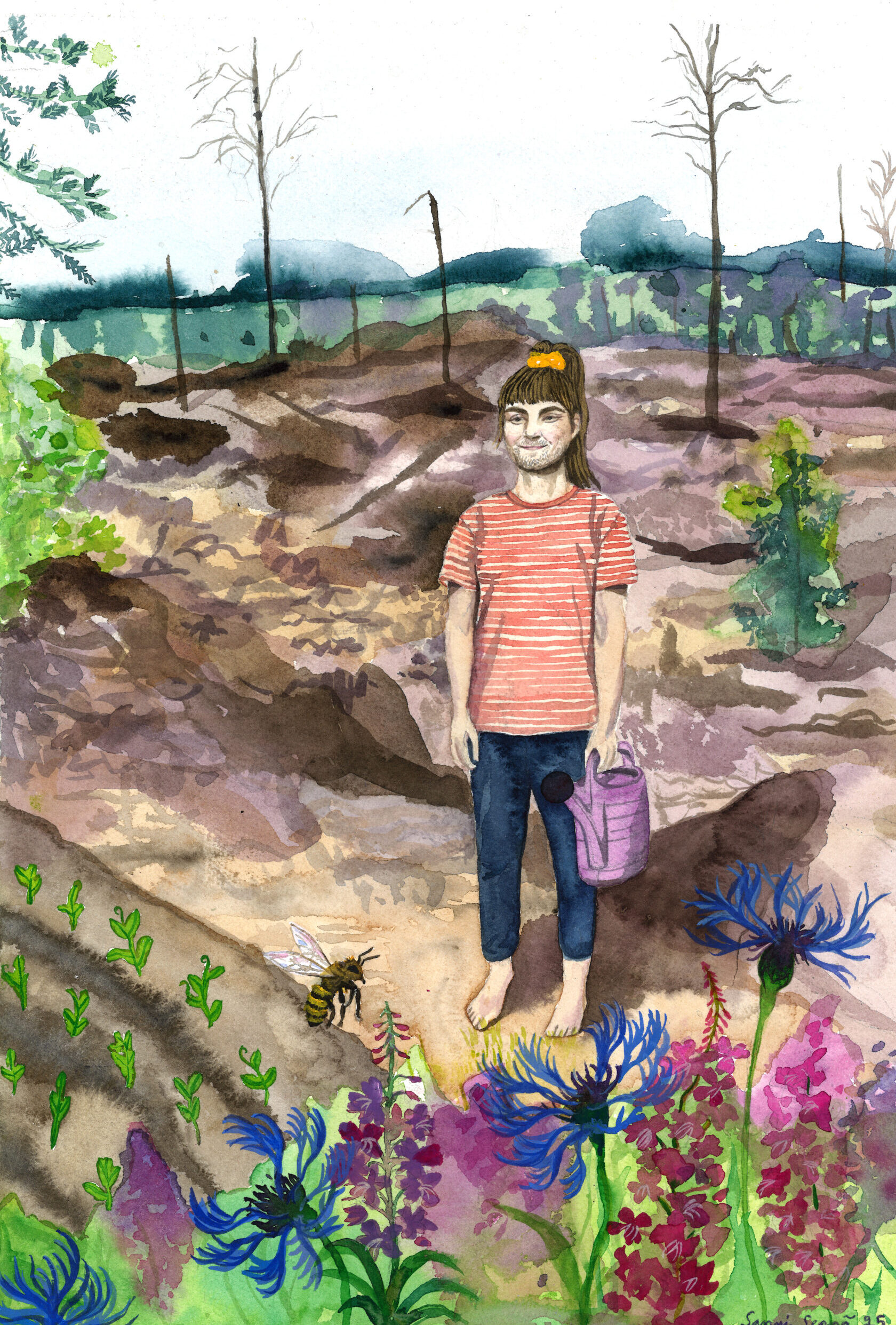
Sanni Seppa, Hope, 2025
[2] By diversified small-scale farms I refer to the kinds of farms that focus on diversified organic production (though not always certified), as in contrast to (techno-industrial or organic) monocrop farming and often integrate animals while also engaging in crop and vegetable production. I acknowledge that ‘small-scale’ is relative and might be an ambiguous way to categorize farms. In the Finnish context, a medium-sized farm is 50ha and a small-scale farm in this context would be a farm cultivating anything from 1ha—40ha and having animals from a few up to 30.
[3] Farmden is a term coined by a regenerative farmer Lee Reich, who defines it as more than a garden and less than a farm. (https://leereich.com)
[4] There is no uniform definition of regenerative agriculture. Most commonly the concept is used in reference to principles and methods of improving soil health and other ecological capacities of agricultural lands. I have argued elsewhere (Kallio 2022; Kallio and LaFleur 2023) that this focus neglects other, equally important dimensions of regeneration, such as community empowerment, resilience and self-determination, and questions of livelihoods. For definitions of regenerative agriculture, see e.g. (Giller et al. 2021; Rhodes 2017; Schreefel et al. 2020).
[5] By ‘strong sustainability’ I refer to an understanding that natural capital is not substitutable by human-made capital (Gutés 1996), and hence, all practices are bound by acting in ways that sustain and regenerate, rather than degrade and degenerate, the living web of life for future generations (see also Houbeckers and Kallio 2022). The counterpart of strong sustainability, namely weak sustainability, then, refers to an understanding of sustainability based on the substitutability of natural capital (i.e., believing in the ability to replace ecological resources), hence allowing an endless extraction from the web of life.
For the past four years, I have been working at diversified small-scale farms, [2] market and forest gardens, and other types of farmdens [3] and have encountered different stories through which people have journeyed into regenerative farming and ended up living off and with the land. These were stories of escaping meaninglessness and searching for a meaning, of seeking to work for the benefit of nature and of refusing to be part of destroying it, of taking responsibility and of giving (it) up.
These were stories of change and continuity, of empowerment and burnouts.
Stories of liberty and sacrifice…
…of hopelessness and hope.
The more I dove into the lives of people engaged in small-scale diversified farming, which I have elsewhere identified as regenerative agriculture [4] (Kallio 2022; Kallio and LaFleur 2023), and the further I followed the developments in the field of regenerative agriculture, the more discomfited I became. While regenerative agriculture has rapidly become a powerful political discourse, a major domain of research and a growing field of development, it is primarily being addressed as a pathway for transitioning so-called conventional agriculture to carbon farming (IPES-Food 2022). This reduction not only disregards other, much broader meanings in farming (Silvasti 2002; Vlasov 2020, see also Kallio 2022; Kallio; LaFleur 2023), but also fails to acknowledge how and why new farmer generations set out to work with and regenerate the land.
More crucially, however, I noticed that this reduction is founded on the production of hope that relies on farmers to contribute to taking care of the ‘carbon problem’ — a hope that has made policy makers and scientists alike captivated by the potential of carbon farming (Heinonsalo 2020; IPES-Food 2022). But while regenerative farmers and (their) soils are being rapidly mobilized into vessels of hope, it is paradoxically often the lack of hope concerning strongly sustainable [5] societal transformations as well as the anxiety aroused by the great unravelling (Macy; Johnstone 2012, see also Jensen 2006) that are moving people (back) to the land to practise regenerative farming — a movement that also my findings support. It is from this kind of ambiguity that this article emerges.
My aim is to explore hope through an ethnographic account by which I wish to make visible the stories and lived experiences of regeneratively oriented small-scale farmers and bring forth an understanding of hope as action. Drawing on the work of Macy; Johnstone (2012) and a relational practice-based research approach (Ingold 2000; Räsänen and Trux 2012), I ask: how is hope manifested in the work of diversified small-scale farmers? Based on a sensory, emplaced and narrative analysis (Pink 2015; Riessman 1993), I show that hope as action, in the context of the studied small-scale diversified farmers, is manifested through cultivating the lands, inspiring others, and reciprocating the hope of other species. I argue that conceptualizing hope as action suggests an essentially different temporal orientation than that of future-orientedness (Bryant; Knight 2019), one that is (literally) grounded in intergenerational farming landscapes (Ingold 1993). Hope as action mobilizes both the past and the future and intertwines them into the present by opening up a pathway to noticing the traces (Tsing 2012) into which hope(s) and hopelessness(es) materialize through the work and dwelling of farmers, who together with other beings shape, sustain, and steward intergenerational farming landscapes.
I suggest that reflecting on both the differences in meanings and in beliefs (Abend 2008) related to the concept of hope, and ultimately, understanding the kind of action it materializes into (or doesn’t) is important for a better understanding of whose hopes are being mobilized through regenerative agriculture and how and why these hopes are mobilized. It may well turn out that giving up false hope towards the future of progress (Kingsnorth 2021; 2023; Lehtinen 2019; Jensen 2006) might not only be necessary, but prove to be the only way to give birth to action that connects humans with the wider web of life and orients them towards regenerating it.
Hope as action
While my aim is not to provide a theory of hope in the sense of any of the understandings of a theory as identified by Abend (2008), I do have a conceptual ambition, namely bringing forth an understanding of hope as action. In order to do this there is, however, a need to start from a completely different understanding of hope — like the one suggested by anthropologists Rebecca Bryant and Daniel Knight in their book The Anthropology of the Future — and start unpacking both the meaning(s) and belief(s) (Davidson 1984:142, cited in Abend 2008) underlying different conceptualizations of hope.
Bryant and Knight (2019), building on an understanding of “temporality as inherently teleological” (ibid. 17), suggest that hope is one of seven orientations towards the future. Based on two examples from political spheres where new chosen leaders arrive with powerful words that awaken people’s hope, the authors identify hope as “a swell of emotion, an affect of positivity, appearing to push the crowds toward a better future. This is not the future of dream, but rather the future of blocked or unrealized potential” (ibid., 134). Hope, in this sense, is depicted asa shared positive emotion — that is not a dream —that orients people towards the future. In characterizing hope in this way, the authors further argue that:
hope emerges in the gap between the potential and the actual, between matter and its not-yet form. Hope is about something that doesn’t presently exist but potentially could; hope is based on more than a possibility and less than a probability. In that sense, hope is a way of virtually pushing potentiality into actuality. (ibid., 134)
It is this abstract, future-oriented understanding of hope — an image of hope as floating-in-the-air — that leaves me puzzled. How does hope, as something caught between the present and the future, relate to action, as something happening here and now?
Looking into the historical trajectories of the production of hope, the playwright and free thinker Ilja Lehtinen (2019) not only departs from the positive connotations of hope but appears critical towards the whole concept. “Speaking in the language of hope” (emphasis original, np.), asserts Lehtinen,happens in the name of false promise of progress and does not appear reasonable in an era where ecological crises and collapse of current civilizations meet. In fact, it is both optimism and future orientedness that Lehtinen criticizes.
In his assessment, the production of hopefulness towards the future is not so much characterized through the linearity of time but rather by “explicitness, controllability and surveyability” of it (ibid., emphasis original, np.). In contrast, Lehtinen suggests, approaching time as “inevitable, destined, and unknown” would make hanging on to immaterial promises of continuing business-as-usu-al, and promises of salvation through technological solutions, meaningless. Giving up hope for a better future, the future of progress would enable one to ground one’s experiences in the present, and teach one to live in the midst of unfolding crises, suggests Lehtinen.
Similarly to Lehtinen, Mariame Kaba, a grassroots organizer and educator, refuses to connect hope to optimism or the future (Scahill 2021; Sonenstein and Wilson 2020), but unlike Lehtinen continues to believe in the possibility of having hope. As a person actively working in and for Black communities to dismantle what she calls the Prison Industrial Complex, Kaba contests the idea of hope being an emotion and advocates for an understanding of hope as a discipline. This understanding came to her from an encounter with a nun and is deeply rooted in religious practice. Thus, for Kaba, hope is produced in action and requires disciplined work: “It is work to be hopeful,” she states (Scahill 2021, np.). In this sense, instead of giving up the concept of hope, like Lehtinen suggests, Kaba seems to redefine its meaning. For her, hope does not assume optimism and future orientedness, but rather, as a discipline it “always [carries] a potential for transformation and for change. And that is in any direction, good or bad” (Sonenstein; Wilson 2020, np.).
While for Kaba, (repetitive) action (re)produces hope, for Macy and Johnstone (2012) it seems to be the other way around. In their book Active Hope, ecophilosopher Joanna Macy and resilience specialist Chris Johnstone bring forth an understanding of hope as becoming active through enabling and prompting action. For Macy and Johnstone the word ‘hope’ has two different meanings:
The first involves hopefulness, where our preferred outcome seems reasonably likely to happen. […] The second meaning is about desire. It is what we do with [this] hope that really makes the difference. Passive hope is about waiting for external agencies to bring about what we desire. Active Hope is about becoming active participants in bringing about what we hope for. (Macy; Johnstone 2012: 3.)
In what follows, I discuss how hope as action, in the context of regeneratively oriented small-scale farming work, leaves tangible traces in farming landscapes that are always and inherently intergenerational and temporally unfolding. I argue that conceptualizing hope as action, or as Active Hope as Macy and Johnstone (2012) propose, suggests a different kind of temporality. This hope is (literally) grounded in the past, which impacts the actions of the present, and the future, which orients the actions of today. Furthermore, as active hope acknowledges the coexistence of hope and hopelessness, it also reveals that they are derived from totally different sources.
As I learned at the diversified small-scale farms where I worked, hope manifested through concrete everyday work and recurrent action. Farmers sow seeds in the hope that they germinate; they tend plants in the hope that there would be a good harvest; they care for soil in the hope that it becomes animate (Puig de La Bellacasa 2019). They observe, experiment and learn to farm better in the hope that others too became inspired and succeed. They learn to notice (Grasseni 2004; Tsing 2012: 17-26) the needs of plants, animals and (other) fellow workers in the hope that such generosity will be reciprocated (Kimmerer 2013).
It is here where acknowledging the larger view of time (Macy; Johnstone 2012) comes to play a significant role in abandoning the understanding of hope as merely a future-oriented emotion as proposed by Bryant; Knight (2019). Conceptualizing hope as action, I suggest, moves beyond the linear perception of time — beyond gazing forward into the future and seeking to catch the ever-escaping promise of unrealized potential (Byrant; Knight 2019) — but instead appears to be more truthful to the temporality of the landscape (Ingold 1993).
This kind of temporality discloses hopeful and hopeless traces of intergenerational pasts, presents and futures, and acknowledges the paces of soil (Puig de la Bellacasa 2015), plants (Kimmerer 2013) and animals. Indeed, working so closely with the manifold living beings that inhabited and shaped farming landscapes put a very particular kind of intergenerational temporality into play: farmers became cognizant of the different lifespans of diverse organisms and materialities. For instance, by making compost they participated in different rhythmic cycles of animal reproduction and became subjected to the timely and time-consuming processes of decomposition emerging from the entwined rhythms of microbes, mycelia, plants, animals and humans (Kallio and LaFleur 2023). Ultimately, it was about recognizing the temporalities of enlivening or degrading soil, of nurturing or cutting down trees, and of helping plants, animals, birds and pollinators to adapt or become extinct in the changing conditions of their habitats.
Aiming to regenerate the landscapes of the present through diversified farming the farmers continued to shape landscape relations inherited from past generations and thereby ended up reconfiguring the trajectories of future generations. Through active hope (Macy; Johnston 2012), the farmers were making the future here and now rather than trying to control it (Lehtinen 2019) — by acting upon that what they desired and hoped for.
But while an understanding of hope as action — as residing in the reproduction of everyday farming life — is very close to an understanding of hope as a disciplined work (Scahill 2021; Sonenstein and Wilson 2020), contrary to what Kaba suggests, the kind of hope that I observed at the farms was activated not on account of its antithesis, hopelessness, but despite it. In other words, while some journeys had started from places of hopelessness, the farmers and other carers of agricultural lands were not pursuing livelihoods through regeneratively oriented small-scale farming because they were hopeless, but because they refused to contribute to ecological degeneration.
Instead, hope was transformed into action in the process of pursuing a completely different desired reality, one that acknowledged the possibilities of more-than-human livelihoods (Houbeckers and Kallio 2022) and one in which utopias were collectively put to work (Alhoj.rvi 2021). In this sense, conceptualizing hope as action requires re-examining the relationship between hope and action. Further, it calls for relinquishing an understanding of hope as something that is abstract, and instead warrants recognizing its materiality.
Hence, speaking of the unfolding of hope through intergenerational farming landscapes is not possible without recognizing how hope(s) and hopelessness(es) of past generations materialize in the conditions of the agricultural lands, lands that have been inherited by the new farmer generations. Equally, recognizing the materiality of hope is to recognize the ways in which agricultural lands are farmed from the position of acting upon the anticipated hope(s) and hopelessness(es) of future generations.
This brings me to the last point that I wish to discuss, namely false hope. While arguing that both hope and hopelessness of past, present and future generations leaves traces in farming landscapes and mobilizes action, it is crucial to point out that farmers’ hope(s) and hopelessness(es) not only arose from different sources but that the hope(s) of farmers were also based on totally different beliefs and understandings of the desired future than those offered by politicians and market actors.
As other thinkers have pointed out more generally (Jensen 2006; Lehtinen 2019; Macy and Johnstone 2012) farmers’ hopelessness also derived from the experience of not having any real agency to guide societal transformation in a desired, strongly sustainable direction. Engaging in farming enabled self-determination and thereby gave the farmers agency to act upon, and an ability to move towards, what they desired. However, what diversified small-scale farmers desired differed greatly from the dominant regenerative agricultural field. While the hope of politicians, financiers and industry actors has increasingly been characterized by the desire to reduce and balance carbon emissions through carbon markets (IPES-Food 2022), selling one’s labour input and offering one’s lands to serve carbon offsetting pursuits was not the hope of the farmers whose journeys I followed.
I would like to end this hope-full journey with the thoughts of Tim Ingold, who, in the preface to the 2021 reissue, discusses the collection of essays published in The Perception of the Environment. Ingold describes how “in the course of writing these essays I began to find renewed hope in a way of thinking that would see our relations with others nestled within the wider field of relations with the very earth on which we dwell, and all that lives and grows from it.” (Ingold 2000: xiv). He then goes on to reflect on the critique he received for depicting the beauty of this world rather than its dissonance. To the critique, Ingold replies:
My response was to say that you cannot tear apart what has not first been woven together; that coherence is a necessary condition for rupture. And it was the nature of this coherence that I wanted to understand. But as the skies darken overhead, I am no longer so sure. […] I know I am not alone in intuiting this contradiction, as it is patently on show in all the debates, anthropological and otherwise, that are struggling with the question of how to live, in a way that would offer hope to future generations. We will have our work cut out, in coming years, to resolve it. (2021, xv)
Indeed, we are living in turbulent times. It remains to be seen what kinds of hopes and states of hopelessness the future generations will carry on and how they will end up resolving living off and with the lands that they inherit. Ultimately, the answer to the question of how to live in a way that would offer hope to future generations might well be giving in to hopelessness, contemplating the Great Unravelling, and giving up false hope (Jensen 2006; Lehtinen 2019; Macy and Johnstone 2012).
Then, what remains, is hope as action: acting here and now from within a “larger view of time” (Macy; Johnstone 2012) and situating oneself within shared stories of our times and unfolding temporalities of intergenerational landscapes. Then, maybe, hope as action can guide us through the world of loss, ruins and extinction (Tsing et al. 2017; Van Dooren 2014) and mark paths towards a world of beauty, miracles and awe.
Soil under the fingernails, or: fieldwork and methods
[6] CSA is an acronym for Community Supported Agriculture. For more information about CSA’s in Finland, see e.g. (Kallio 2018; Ruralia 2023)
[7] NÄKYMÄ is a website that presents research results on the project Invisible work in regenerative agriculture funded by the Kone Foundation. Link to the site: www.nakymatontyo.fi
[8] I use this expression from Donna Haraway’s book Staying with the Trouble: Making Kin in the Chthulucene, to refer to a collective reflection of troubling times and efforts to think-with multispecies communities (Haraway 2016).
[9] I position my work within relational-material practice ontoepistemology, which situates humans as part of the biosphere and acknowledges that human interaction is always intimately entwined with the dwelling and activities of species and more-than-human materiality (see e.g. Ingold 2000, Kimmerer 2003).
I started my fieldwork in Finland at the beginning of 2019. At that time the term regenerative agriculture was barely known to people outside the ‘pioneering’, or ‘alternative’ farming communities that I studied. Among these people, it was a concept used to refer to farming in a holistic and an organic manner with conscious reflection on the sustainability and ethics of the practices applied to produce food. Quite soon, I came to observe, the concept of regenerative agriculture became co-opted by food industry actors and started to be used in the context of conventional agriculture and in reference to ‘regenerative practices’ such as sowing cover crops to keep soils green as long as possible, using low or no-till methods, or reducing (but not necessarily giving up) the use of pesticides. Moreover, regenerative agriculture came to be rapidly reduced to what has now become known as carbon farming. Therefore, it has become difficult, if not impossible, to use this concept to refer to farming practices arising from a completely different paradigm than that of conventional farming in a transition that is deeply connected to the techno-industrial agrifood complex. Hence, I speak of a regenerative orientation and diversified small-scale farming.
The farms that I worked on included farms practising organic farming, biodynamic farming, market gardening and forest gardening. Some followed permaculture and agroecological principles, others referred more explicitly to regenerative farming methods (and a few more explicitly to carbon farming) that they were learning from practitioner books, peer-to-peer networks, YouTube videos and by following ongoing scientific research. Altogether, I visited 16 farms and worked at 10 farms for varying periods of time throughout different seasons.
My tasks included almost everything except driving tractors and helping with the birth of animals. I sowed seeds and prepared beds, I did weeding and transplanting, I harvested and prepared vegetables for sales or for food bags to be delivered to CSA [6] members, I fed animals and cleaned their barns, I cleaned farm spaces and prepared lunches, and I did many other things that came up as part of the farmers’ everyday lives whenever I was present.
In addition to recording many of the spontaneous conversations happening alongside work and other activities at the farms, taking photos and writing notes in my field diary, I conducted ten semi-structured interviews that I codesigned together with the farmers. These were video recorded and published in NÄKYMÄ [7]. While hope was not a concept I explicitly inquired into, or a topic that was often addressed during the fieldwork, I started to sense the presence of something resembling hope the more time I spent on the farms. I used my sensory experiences to try, as Pink (2015, 54) describes, “to access areas of embodied, emplaced knowing and [to] use these as a basis from which to understand human environments, activities, perception, experience, action and meaning”. To my surprise, this method allowed me to notice how, in many of our conversations at the farms, we kept returning to staying with the trouble(s) [8] rather than spending our time envisioning a more hopeful future.
Drawing on a relational approach (Ingold 2000) and the framework of practical activity (FPA) (Räsänen and Trux 2012), as well as on an understanding that practices are always more-than-human [9] and unfold through the temporalities of the landscapes (Ingold 1993), my analysis of hope proceeded in two stages. In the first part of the analysis, I focused on the stories of how people went into farming, analysing how and why people ended up practising diversified regenerative farming. The stories that I compiled from my field notes, interview transcripts and transcripts of everyday conversations during the fieldwork revealed how the coexistence of hope and hopelessness encompassed both the past and the future of the farmers’ journeys. I describe these findings in the next section titled ‘Thus called the land’.
The second part of the analysis included two phases. First, in inquiring more deeply into the actual practices of regeneration, I specifically focused on what regeneration meant at each farm, and (hence) what were the things farmers and land stewards were working towards, analysing both the how and the why. Second, I made a word search for hope in all the written and transcribed research material. This search brought me hits from six different farms out of 16. When going through the parts where hope was explicitly mentioned I realized that most of the excerpts were extremely mundane, in parts even dull, mentioning hope as part of and connecting it to concrete action. Analysing excerpts with mentions of hope together with accounts of the hows and whys of regenerative farming resulted in identifying hope as action characterized as cultivating the lands, inspiring others and reciprocating the hopes of other beings. I describe these findings in the section titled ‘Be the change’.
Thus called the land
[10] All the names of the farmers have been anonymized and pseudonyms are used instead.
[11] The field notes have primarily been written in Finnish, and have been translated into English by the author.
In bare feet and hands covered in soil she meets me with a warm hug. We have never met before and yet it feels like we’ve known each other for a long time. As we walk through a wooden arch- shaped entrance into a path surrounded by plants of different shapes, colours and heights, most of which I do not recognize, Ulrika [10] me how she ended up living on this piece of land far from where she grew up. Neither of her parents have a farming background, but Ulrika declares that she can’t imagine doing anything else than, as she puts it, serving this land. “My story probably begins from college. I didn’t have much direction at that time, but I knew that my hands belong to [be in] the earth, and that was the direction towards which I started to journey,” she reminisces (Field diary, 2020).
This was one of the many stories that I encountered in my fieldwork. I found two kinds of storylines: the stories of those people who did not grow up on a farm and did not have a farming background through family —whom some scholars refer to as back-to-the landers (Halfacree 2007; Vlasov 2020;Wilbur 2013) — and the stories of those who did. What these storylines had in common was that in both cases people journeyed towards something they considered meaningful and away from action that appeared to be contributing to the ongoing ecological crises. In the words of Macy and Johnstone (2012), it was the great transformation that I was witnessing.
Some of the people whom I encountered were career changers who had never farmed before, but were drawn to the work as small-scale farmers. Ahti was one of these people. He did not wish to enter the academic world, as it did not seem to him to have a purpose, but neither did his chosen profession as a technician that he worked at for ten years feel meaningful on a deeper level. Consequently, he ended up quitting his job and moved into farming.
Anthony, on the other hand, received an academic education and began working as a key account manager at a large tech company. However, like Ahti, Anthony felt that the work that he did at that time was not meaningful, but rather the contrary; his work contributed to the climate change that he was becoming increasingly aware of and anxious about:
Absolutely not [no background in farming]. I grew up in cities all over the world. […] At some point, I realized that I wanted to create a world in which I was able to live in accordance with my ethics […] the real crisis of our time was global warming. And I sort of became more and more aware of that […] I’m just not going to… I don’t want to be a part of that karma or that cycle of destruction […] and so I started moving more towards working with ecosystems. (Transcripts, 2019)
Indeed, many urbanites who were drawn to small-scale and sustenance farming were well aware of global warming and felt the need to do something about it, something concrete, as Joonas did:
I was studying [at university] and I learned about climate change and a number of other issues facing people everywhere and tried to figure out something concrete that I could do beyond typical activism. […] I wanted to eat better food and so I became interested in gardening. So, gardening became an interest in what is organic farming? Is there anything better than organic farming, what can we do? And so I just found that path to be extremely gratifying, working outside with plants and nature and compost… (Interview 7)
Other people also drifted into farming through becoming interested in the origins of food. Also, communal living in the countryside was an attraction to some, like Iris, her partner, and their friends:
I don’t have an agricultural background at all. I have grown up in a suburban area in a town. […] Many [of us participating in a food collective] had a dream of living [more sustainably] in the countryside and we were interested in the origins of our food. (Transcripts, 2019)
People without a farming background moving from urban to rural areas needed to acquire a piece of land and often started building gardens from scratch — on “waste lands”, “deserted fields”, or “plots occupied by trees” — with the hope of being able to regenerate these landscapes.
I observed similar aspirations among people who grew up on a farm and wanted to continue farming on the lands that had been cultivated by their families for decades, if not for centuries. This younger generation of farmers seemed to have in common an impulse to take care of the landscape and improve the overall condition of the soils and the surrounding ecosystems. One farm was run by siblings who continued in the footsteps of their grandfather:
The girls’ father started to reflect on the condition of the fields here at our family farm, and he has a connection to biodynamic farming through his background and so he somehow wanted, felt the need for us, to start taking care of the land… (Transcripts, 2021)
Environmentally conscious farming also guided Jyrki, who continued his old family farm, and converted it into an organic farm that nowadays operates as a community supported agricultural cooperative:
I was born and grew up here at this farm and have been participating in the work as much as I could since I was little. […] And then also environmental issues have gained prominence and were already important when I was little. So, going organic was quite self-evident for me. […] And now we also have this farmer cooperative and CSA here. (Interview 8; transcripts, 2019)
Many of the stories that I heard made visible future-oriented aspirations to move towards what people found desirable, namely working on and with the lands and producing food in a regenerative manner. At the same time, reflecting on the past was intrinsic to regeneratively oriented farming, which provided a path for moving away from the trajectories of degeneration that people were witnessing.
In the many different places where I worked, I encountered a similar viewpoint: that the actions of the past generations had had a severe negative impact on farming lands and on the living environment more broadly. Things were heading in the wrong direction and that not enough was being done to reverse the ongoing environmental destruction. I recall one conversation with Jyrki about what would “locally adapted ecological farming“, as he called it, be like. He said in passing: “I don’t believe that any significant changes will happen in the society by that time [when the next generation takes over this farm].” This notion encapsulated many conversations to come.
Some farmers felt that not only were things bad but that they were getting much worse, and through regenerative farming they were preparing for what Bendell (2018) identifies as a societal collapse. In one conversation with Anthony, we were discussing the power of corporations to control seed supply. And while he was saving seeds as an intrinsic part of farming, and participating in various seed-saving communities, he was not optimistic about the future of indigenous, non-patented seeds:
We don’t know what follows. […] It’s a code that’s evolved, and there’s all these checks and balances that have been built into the [seed] structure, for literally billions of years, and now, suddenly, one species and only a very small percentage of that one species has a shitload of power and money, and technology, they’re gonna go in and they’re gonna decide how that code is gonna evolve. […] So, if these people have the means of reproduction, they can out-compete anyone else in reproduction, because they can firstly manipulate, then they also patent it. […] They have a huge advantage. Huge advantage. And they will probably use it to fuck everything up. We have no idea what kind of crazy shit we’re gonna get out of that. (Transcript 2019)
[12] By ‘self-reliant food economies’ I refer to practices of food provisioning that are organized independently at grassroots level, and which are not subordinated to the rules and regulations of the conventional market-based economies and food (safety) regulations (see Houtbeckers and Kallio 2019; Kallio and Houtbeckers 2022 for the conceptualization and use of the concept of self-reliant food economies).
Some even expressed the idea that regeneratively oriented diversified farming and engaging in self-reliant food economies was a potential threat to established institutions, and hence this way of farming had been made very difficult. By listening to these concerns, I realized that for these farmers, when judging the actions of the past and the present, there was simply not enough evidence for any kinds of strongly sustainable improvements — neither in the political nor in the market spheres — to take place in the near future.
The stories of how and why people were called to work on the lands revealed the entangled temporalities of the landscapes (Ingold 1993) that farming activities evoked. Loss of faith in the current system, or the story of the Great Unravelling as Macy and Johnstone (2012) put it, was as deeply attached to the past and present traces in the landscapes as it was connected to creating new traces through farming. As hopelessness unravelled in the lives of the farmers, space for another kind of trajectory, one that was deeply connected to today’s actions, began to unfold.
Be the change
At the end of a long day, I sit in the car and drive home with my notebook, camera and a bag of food that has been given to me. During the day I’ve fed the cows by carrying them hay bales, I’ve carried vegetable bags of 20kg into the cellar and out of it, I’ve washed, weighed and packed hundreds of kilos of root vegetables to be delivered to customers, I’ve filled the shelves of the farm store, helped to make lunch and set and cleaned the table for a crew of nearly ten people. When I leave, I know that the farmer continues the day by delivering the vegetables we’ve prepared for sales, by orienting for and scheduling the next day’s to-do list, by participating in taking care of the family needs, by feeding the cows twice more that evening, and by doing some accounting before eventually falling dead tired into bed. (Fieldnotes 2022)
This farm was not the only farm with days requiring more hours than there are in a day. As the main growing season only lasted for some three months, particularly on those farms that primarily focused on seasonal annual vegetables, the work during this time was very intensive. Nearly all farmers, gardeners and servants of the land appeared on the verge of burnout, and there was always much more that could have been done but couldn’t be. It was exactly this kind of everyday, recurrent physical labour that embodied hope for building a better future on the one hand and complete loss of faith for any true change to happen in the society at large on the other. But this ambiguity, the mutual constitution of these two incommensurable dimensions of hope, turned dirt into soil, grass deserts into pollinators’ paradises, hundreds of hectares of solitude into community-supported agriculture.
Taking action into one’s own hands and practising diversified agriculture, market and forest gardening in a self-determined manner provided the farmers a counter force to the lack of hope that they were experiencing regarding a larger societal change. In the landscapes that I visited, I found, as Macy; Johnstone (2012) put it, that hope was active. In the following I describe how hope was manifested through i) cultivating the lands, ii) inspiring others, and iii) reciprocating the hope of other species.
Cultivating the lands
Soil and the condition in which it was inherited played an important role in the work of the farmers. What united all farmers, gardeners and servants of the lands was stewardship, as they were all working to improve the health of the soil and the surrounding landscapes in order to bring them more to life.
Some soil was approached with ploughs, other soil with bare hands. Some farms were turned into perennial forest gardens, some into animal pastures and traditional biotopes, some were converted into oases of diversified annual vegetable gardens, and some became experimental sites for carbon farming. All these different landscapes unfolded through active shaping of different species, including humans, that inhabited, worked at, or passed through the landscapes.
As part of applying different regenerative practices, the farmers actively monitored their landscapes and many reported that they could sense the vitality of soils and observe improved plant growth and the appearance of diverse insects, birds and animals. Marika described their observations as follows:
We have this experience [here] and a sensation about how our ways of farming and [increasing] biodiversity has changed the soil, the land, into a totally different form, and how being in the fields feels [now] completely different from when we started. (Transcripts 2021)
Harri also observed the concrete results of his farming efforts as he worked in synchronicity with nature’s rhythms: “When I work together with nature and in this amazingly diverse and tangible farm organism, I see very concretely every day how nature’s metamorphosis works, and I can join it, because I’m in the same location.” (Interview 5).
Some farmers told stories about other people who had been applying regenerative agricultural practices consciously for decades, or even just for a few years, and who were ”turning things around”. Being able to learn from others that it was possible to transform a piece of land to have “the best soil in the county”, even where chemicals had previously been used, even where the soils had been “poisoned” and converted to “dirt”, and wastelands, gave a lot of hope to continue one’s own regenerative work.
Being able to take care of the lands and produce ‘good food’ (Kallio 2020) in an autonomous manner and in accordance with one’s beliefs, and witnessing the concrete material results of one’s own work empowered the farmers and generated hope. Many considered that farming had a lot of potential to make an impact on other people and to make a change in the proximate environment, as Iris stated: “These kinds of farms impact hundreds of people.” (Fieldnotes 2020).
The fruits of one’s labour came in many different forms, but what seemed to ground them was a very special temporal orientation, namely, intergenerationality:
For me this [regenerative work] is very hopeful. I am extremely touched when I plant a tree, which is so intergenerational. (Interview 2)
So that we can cultivate these lands for the next thousands of years we need to take care of them as well as we can. (Interview 6)
These hopes for intergenerational care and continuity were infused into concrete action, and most of all, hope was planted and replanted in the mundane, everyday farming work, guided by pursuing self-reliant and autonomous ways of regeneration, where the means of (re)production stayed under the control of the farmers and (other) stewards of the lands. The ambiguity of hope was present in every seed sowed, plant planted, animal reproduced or killed, harvest sold or unsold, as Anthony states:
And it’s not like I’m under any kind of illusion that this is going to save the world. It isn’t. But if everybody went in this direction or some kind of similar direction where they’re relating with biology, relating with ecosystem, then … (Interview 3)
Something very essential was captured in Anthony’s words. Hope was planted in and through concrete action, but there needed to be someone to acknowledge the impacts of that which was sowed and cultivated.
Inspiring others
At the very core of the practices of regenerative farmers and stewards of the land was a desire to demonstrate that these kinds of ways of farming and (re)producing food were viable. Similar to being inspired by other regenerative farmers, whose books some people had been reading or whom they were following on the social media, many wished to be able to inspire others — farmers of today and of tomorrow — through the work they were doing and through the landscapes they were (co)creating and shaping.
The underlying hope of many farmers was to facilitate more regenerative farms in the future. They hoped that they could provide guidance and support the learning needed for this kind of development, despite the fact that some felt that regenerative agriculture was a threat to the broader market-based society, as noted by some farmers: “this [diversified small-scale regenerative farming] is not wanted in the bigger picture, that’s for sure. The global monetary economy is driving in a completely opposite direction, the direction of control.” (Transcript 2021).
Many seemed to want to validate diversified small-scale farming, as Joonas put it: “what I’m trying to do is just have a small-scale business that’s profitable enough that it’s going to hopefully inspire more, especially young people, to see that farming in Finland is a viable option” (Interview 7). For many, the concrete farming work was in itself inspirational and empowering. Many described how it gave them strength and a sense of autonomy, provided meaning and continuous inspiration. People working on farms and at homestead gardens generally saw that regenerative farming had a lot of potential for bringing about change, and even for providing a totally different paradigm of livelihoods compared to what the dominant consumption-driven society offered.
For many farmers, doing things together and enabling communities to form around and support small-scale farming was at the core of the required paradigm shift. Indeed, on some farms I observed a continuous flow of people who came to work, help or visit. These were friends and acquaintances, trainees and volunteers, school groups and political delegations, other farmers and researchers like myself. These were the people who had the potential to be inspired. Particular farms were known for their successful regenerative work and admiring appraisals of them circulated by word of mouth. Some farmers, however, were rather humble, underestimating the impact they might have as a source of inspiration. Ahti was one of them.
After working periodically at Ahti’s farm for one year we sat down to record a video interview. Our conversations during our workdays had always flowed very well, but then, in front of the camera, it proved to be difficult for Ahti to articulate his achievements. When I asked why he finds regenerative farming important there was a long silence after the familiar answer he gave — namely, that it is important to take care of the soil, the animals and the local ecosystems. Then in a lowered and soft voice, he said: “That we can work together [here] and produce great results…maybe that gives people some hope. For me, an essential part of being regenerative is that people have a place in it.” (Interview 6, author’s emphasis, based on a contextual understanding of the conversation)
Again, there was something very concrete and material in the hope of being able to inspire. Making a more liveable planet was not about talking and hoping that these beliefs would somehow magically materialize, but it was about walking the talk, about doing, observing and witnessing the impact of taking concrete action into one’s own hands in the immediate environments. Hoping to be or to become an inspiration was also a hope to make other people experience the beauty and virtue of regenerative work. Juha described this as follows:
But this planet is actually rather fragile and we need to do everything we can and then to find out that you can actually produce lots of food this way, you can clean the water, you can bring back biodiversity, you can bring back excitement, you can have healthy communities, people [would] want to become farmers again, they want to own land, they want to live out in the countryside where they can, when they’re actually told they can interact with this miraculous thing… (Transcripts 2020)
Interacting with the miraculous thing called the Earth gave hope, but for some, at some point in their journey, it appeared to relocate hope and shift people’s perspectives of whose hopes farming work was serving.
Reciprocating the hopes of other living beings
Hope did not merely exist for and because of humans, it also came in a form that departed from an understanding of hope as a characteristic of human behaviour alone. Working in multispecies environments, continually pursuing knowledge about how other species contributed to making and shaping landscapes enabled farmers to better understand — and be interested in learning more about — the needs and aspirations of other species. This made some people reflect on the hopes of living beings beyond humans, whom Barron and Hess (2020) call the “earth-others”.
At a biodynamic farm, Iris was taking a group of students for a walk in some surrounding pastures where traditional biotopes had been revived and sustained. She explained how “plants and nature, actually, somehow await and hope for us to see them. Interaction is as much a gift for them as it is for us.” (Transcripts 2020).
Acknowledging the needs and hopes of other living beings was embedded in farming, albeit in various ways. Despite the fact that the farmers worked within multiple ways of knowing the(ir) landscapes, they all seemed to share an understanding that they were not merely working for themselves, but for the land that had been degenerated and for the generations to come. Being able to work in intimate connection with the more-than-human world and towards acknowledging its silenced hopes helped some farmers to cope despite the hard work:
What helps me manage and is significant on the personal level is my relationship with nature and particularly with animals, this continuous co-living and sensing in my proximate environment. I get [back] at least what I hope to be able to give, and these ties that we make are very strong. (Interview 2)
Then with plants, I experience that it has a meaning that we do this work with our [bare] hands and with [conscious] presence. It is like the Earth wants to be touched…That’s why I want to place my bare skin to her skin. (Fieldnotes 2021)
Indeed, in the midst of planting seedlings in muddy fields, “cleaning” vegetable beds of weeds, or shovelling manure in the cowhouses, many described how the concrete feeling of sticking one’s hands into soil, meeting a wild animal in the garden at dawn, or tending the plants brought an ‘authentic’ feeling of being a human being out of them. But forming intimate relations with the soil, plants and animals and attending to the diverse rhythms of (re)production (Kallio and LaFleur 2023) not only enabled the farmers to recognize the hopes of other-than-humans, but also made them recognize and appreciate the reciprocity of more-than-human relations.
Reciprocal relations manifest themselves in many ways, but at the core was the ability of the farmers to acknowledge the hopes of other living beings. The hope of plants, animals, birds, fungi and sometimes even the hope of water — as Ulrika mentioned, “the water wants to flow freely, and not be captured in a static deposit” (Fieldnotes 2021) — would enter into the sphere of reciprocal relations.
Creating reciprocal relations with plants, animals and other living beings in the landscapes meant giving something back to them, not merely taking from them. Reciprocity was manifested, for instance, in the practice of composting. Making compost was an engagement which required a lot of work and time that could have been avoided by purchasing fertilizers or by outsourcing the making of compost. However, using one’s own compost was an expression of caring for the soil (Puig De La Bellacasa 2015) and was considered an act of giving back the nutrients that were taken from the soil by the harvest.
These kinds of practices that emerged from the need to reciprocate brought the farmers and other carers of the land to reflect upon the connections between the wellbeing of people and of the land: “It’s about human flourishing […] what keeps our society going is the way we manage land, and you can see the soil health reflected in the health of the people, and [at the moment] people aren’t happy.” (Interview 6).
At the end of the day, recognizing the hopes of other living beings inhabiting and shaping the farming landscapes amounted to a recognition of one’s own sources of illness and wellbeing, sorrow and happiness.
Hope and unfolding temporalities of intergenerational farming landscapes
In its present form, a tree embodies the entire history of its development from the moment it first took root. And that history consists in the unfolding of its relations with the manifold components of its environment, including the people who have nurtured it, tilled the soil around it, pruned its branches, picked its fruit, and – as at present – use it as something to lean against. The people, in other words, are as much bound up in the life of a tree as is the tree in the lives of the people. (Ingold 1993, 197-198)
As a tree grows from a temporally unfolding landscape, the seed of this tree has been sown and the tree nurtured through hope. Motivated by developing an understanding of hope as something that people do (Macy and Johnstone 2012, see also Graeber 2001) rather than something that people have (Bryant; Knight 2019, Lehtinen 2019), my aim has been to make visible how hope is materialized in actions like those Ingold (ibid.) describes in the quote above when analysing Bruegel’s The Harvesters. Acts such as sowing seeds, nurturing plants and trees, caring for more-than-human communities, and harvesting I identified as cultivating the lands. Observing the growth, regeneration and the temporal unfolding of the landscapes and sharing this knowledge with others, is identified as inspiring others. Finally, leaning on a tree, looking at it, smelling its flowers and eating its fruits, and attending to the hopes of multiple other living beings who wish to be nurtured, is reciprocating the hopes of other living beings. All these activities emerge from hope.
In what follows, I discuss how hope as action, in the context of regeneratively oriented small-scale farming work, leaves tangible traces in farming landscapes that are always and inherently intergenerational and temporally unfolding. I argue that conceptualizing hope as action, or as Active Hope as Macy and Johnstone (2012) propose, suggests a different kind of temporality. This hope is (literally) grounded in the past, which impacts the actions of the present, and the future, which orients the actions of today. Furthermore, as active hope acknowledges the coexistence of hope and hopelessness, it also reveals that they are derived from totally different sources.
As I learned at the diversified small-scale farms where I worked, hope manifested through concrete everyday work and recurrent action. Farmers sow seeds in the hope that they germinate; they tend plants in the hope that there would be a good harvest; they care for soil in the hope that it becomes animate (Puig de La Bellacasa 2019). They observe, experiment and learn to farm better in the hope that others too became inspired and succeed. They learn to notice (Grasseni 2004; Tsing 2012: 17-26) the needs of plants, animals and (other) fellow workers in the hope that such generosity will be reciprocated (Kimmerer 2013).
It is here where acknowledging the larger view of time (Macy; Johnstone 2012) comes to play a significant role in abandoning the understanding of hope as merely a future-oriented emotion as proposed by Bryant; Knight (2019). Conceptualizing hope as action, I suggest, moves beyond the linear perception of time — beyond gazing forward into the future and seeking to catch the ever-escaping promise of unrealized potential (Byrant; Knight 2019) — but instead appears to be more truthful to the temporality of the landscape (Ingold 1993).
This kind of temporality discloses hopeful and hopeless traces of intergenerational pasts, presents and futures, and acknowledges the paces of soil (Puig de la Bellacasa 2015), plants (Kimmerer 2013) and animals. Indeed, working so closely with the manifold living beings that inhabited and shaped farming landscapes put a very particular kind of intergenerational temporality into play: farmers became cognizant of the different lifespans of diverse organisms and materialities. For instance, by making compost they participated in different rhythmic cycles of animal reproduction and became subjected to the timely and time-consuming processes of decomposition emerging from the entwined rhythms of microbes, mycelia, plants, animals and humans (Kallio and LaFleur 2023). Ultimately, it was about recognizing the temporalities of enlivening or degrading soil, of nurturing or cutting down trees, and of helping plants, animals, birds and pollinators to adapt or become extinct in the changing conditions of their habitats.
Aiming to regenerate the landscapes of the present through diversified farming the farmers continued to shape landscape relations inherited from past generations and thereby ended up reconfiguring the trajectories of future generations. Through active hope (Macy; Johnston 2012), the farmers were making the future here and now rather than trying to control it (Lehtinen 2019) — by acting upon that what they desired and hoped for.
But while an understanding of hope as action — as residing in the reproduction of everyday farming life — is very close to an understanding of hope as a disciplined work (Scahill 2021; Sonenstein and Wilson 2020), contrary to what Kaba suggests, the kind of hope that I observed at the farms was activated not on account of its antithesis, hopelessness, but despite it. In other words, while some journeys had started from places of hopelessness, the farmers and other carers of agricultural lands were not pursuing livelihoods through regeneratively oriented small-scale farming because they were hopeless, but because they refused to contribute to ecological degeneration.
Instead, hope was transformed into action in the process of pursuing a completely different desired reality, one that acknowledged the possibilities of more-than-human livelihoods (Houbeckers and Kallio 2022) and one in which utopias were collectively put to work (Alhoj.rvi 2021). In this sense, conceptualizing hope as action requires re-examining the relationship between hope and action. Further, it calls for relinquishing an understanding of hope as something that is abstract, and instead warrants recognizing its materiality.
Hence, speaking of the unfolding of hope through intergenerational farming landscapes is not possible without recognizing how hope(s) and hopelessness(es) of past generations materialize in the conditions of the agricultural lands, lands that have been inherited by the new farmer generations. Equally, recognizing the materiality of hope is to recognize the ways in which agricultural lands are farmed from the position of acting upon the anticipated hope(s) and hopelessness(es) of future generations.
This brings me to the last point that I wish to discuss, namely false hope. While arguing that both hope and hopelessness of past, present and future generations leaves traces in farming landscapes and mobilizes action, it is crucial to point out that farmers’ hope(s) and hopelessness(es) not only arose from different sources but that the hope(s) of farmers were also based on totally different beliefs and understandings of the desired future than those offered by politicians and market actors.
As other thinkers have pointed out more generally (Jensen 2006; Lehtinen 2019; Macy and Johnstone 2012) farmers’ hopelessness also derived from the experience of not having any real agency to guide societal transformation in a desired, strongly sustainable direction. Engaging in farming enabled self-determination and thereby gave the farmers agency to act upon, and an ability to move towards, what they desired. However, what diversified small-scale farmers desired differed greatly from the dominant regenerative agricultural field. While the hope of politicians, financiers and industry actors has increasingly been characterized by the desire to reduce and balance carbon emissions through carbon markets (IPES-Food 2022), selling one’s labour input and offering one’s lands to serve carbon offsetting pursuits was not the hope of the farmers whose journeys I followed.
I would like to end this hope-full journey with the thoughts of Tim Ingold, who, in the preface to the 2021 reissue, discusses the collection of essays published in The Perception of the Environment. Ingold describes how “in the course of writing these essays I began to find renewed hope in a way of thinking that would see our relations with others nestled within the wider field of relations with the very earth on which we dwell, and all that lives and grows from it.” (Ingold 2000: xiv). He then goes on to reflect on the critique he received for depicting the beauty of this world rather than its dissonance. To the critique, Ingold replies:
My response was to say that you cannot tear apart what has not first been woven together; that coherence is a necessary condition for rupture. And it was the nature of this coherence that I wanted to understand. But as the skies darken overhead, I am no longer so sure. […] I know I am not alone in intuiting this contradiction, as it is patently on show in all the debates, anthropological and otherwise, that are struggling with the question of how to live, in a way that would offer hope to future generations. We will have our work cut out, in coming years, to resolve it. (2021, xv)
Indeed, we are living in turbulent times. It remains to be seen what kinds of hopes and states of hopelessness the future generations will carry on and how they will end up resolving living off and with the lands that they inherit. Ultimately, the answer to the question of how to live in a way that would offer hope to future generations might well be giving in to hopelessness, contemplating the Great Unravelling, and giving up false hope (Jensen 2006; Lehtinen 2019; Macy and Johnstone 2012).
Then, what remains, is hope as action: acting here and now from within a “larger view of time” (Macy; Johnstone 2012) and situating oneself within shared stories of our times and unfolding temporalities of intergenerational landscapes. Then, maybe, hope as action can guide us through the world of loss, ruins and extinction (Tsing et al. 2017; Van Dooren 2014) and mark paths towards a world of beauty, miracles and awe.
Acknowledgements
I wish to thank all the farmers who have allowed me to work alongside them, learn new skills, and enter spaces of sharing and intimacy. Their openness and generosity have filled me with gratitude and showed me the incredible complexity of the web of life that sustains us. I also wish to express my gratitude to Marja-Liisa Trux for inspiring and thought-provoking feedback on an earlier version of the manuscript as well as Will LaFleur and Eeva Houtbeckers for encouraging comments.
Funders
This article has been written as part of the project titled More-than-human economies in the era of ecological crises — tracing human-soil relations, reciprocity and livelihoods in practices of regenerative food (re)production funded by the Research Council of Finland (former Academy of Finland). The ethnographic fieldwork undertaken for this article has been initiated as part of projects funded by the Maj and Tor Nessling Foundation, the Kone Foundation, and the Ministry of Agriculture and Forestry of Finland.
Author
Galina Kallio is an environmental social scientist with a background in critical organization studies. She is currently working at the University of Helsinki, Ruralia Institute. Her research focuses on farming livelihoods, diversified small-scale agriculture, self-reliant food economies, and more-than-human landscape relations. As a scholar deeply immersed in ethnographic practice, she is also interested in multi-sensory research methods, multispecies processes of knowledge production, and alternative ways of representing science.
Sources
Fieldwork material
Interview material published on [webpage]:
–Interview 1. October, 2021, Southern Finland. Female, 30-50 years. Interviewer Galina Kallio
–Interview 2. October, 2020, Southern Finland. Female, 40 years. Interviewer Galina Kallio
–Interview 3. June, 2019, Norway. Male, 40-50 years. Interviewer Galina Kallio
–Interview 4. November, 2019, Central Finland. Female; Male, 50 years. Interviewer Galina Kallio
–Interview 5. December, 2019, Central Finland. Male, 40 years. Interviewer Galina Kallio
–Interview 6. October, 2019, Southern Finland. Male, 40 years. Interviewer Galina Kallio
–Interview 7. November, 2019, Southern Finland. Male, 40 years. Interviewer Galina Kallio
–Interview 8. November, 2019, Southern Finland. Male, 40 years. Interviewer Galina Kallio
Interview material, in the possession of the author, stored at the University of Helsinki project group folder:
–Transcripts. Recorded conversations during the fieldwork, 2019. Interviewers Galina Kallio; Risto Musta.
–Transcripts. Recorded conversations during the fieldwork, 2020—2022. Interviewer Galina Kallio.
–Field diaries, 2019–2022.
Bibliography
Abend, Gabriel. 2008. “The Meaning of ‘Theory.’” Sociological Theory 26 (2): 173–99.
Bendell, Jem. 2018. Deep Adaptation: A Map for Navigating Climate Tragedy. Institute for Leadership and Sustainability (IFLAS) Occasional Papers Volume 2. University of Cumbria, Ambleside, UK.
Bryant, Rebecca, and Knight, Daniel M. 2019.The Anthropology of the Future. Cambridge University Press.
Davidson, Donald. 1984. Inquiries into Truth and Interpretation. Oxford: Oxford University Press.
Giller, Ken E, Hijbeek, Renske, Andersson, Jens A., and Sumberg, James. 2021. “Regenerative Agriculture: An Agronomic Perspective.” Outlook on Agriculture 50 (1): 13–25.
Grasseni, Cristina. 2004. “Skilled Vision. An Apprenticeship in Breeding Aesthetics.” Social Anthropology 12 (1): 41–55.
Halfacree, Keith. 2007. “Back-to-the-land in the Twenty-first Century–Making Connections with Rurality.” Tijdschrift Voor Economische En Sociale Geografie 98 (1): 3–8.
Haraway, Donna J. 2016. Staying with the Trouble: Making Kin in the Chthulucene. Duke University Press.
Heikkurinen, Pasi, and Ruuska, Toni. 2021. Kestävän Elämän Manifesti. Elonkehä-kirjat. Vihreä elämänsuojelun liitto ry.
Heinonsalo, Jussi. 2020. Hiiliopas. Katsaus Maaperän Hiileen Ja Hiiliviljelyn Perusteisiin. 1. Painos. Kaarina: Paino-Kaarina.
Houbeckers, Eeva, and Kallio, Galina. 2022. “Kohti Vahvaa Kestävyyttä Ja Heikkoa Tietämistä: Monilajista Toimeen Tulemista Pohjolassa.” Elonkehä, no. 3/22.
Houtbeckers, Eeva, and Kallio, Galina. 2019. “Talous Käytäntöteoreettisesti: Kotitalouksien Omaehtoinen Ruuanhankinta Taloutta Koskevan Tiedon Lähteenä.” Tiede; Edistys, no. 2: 150–69.
Ingold, Tim. 2000. The Perception of the Environment: Essays on Livelihood, Dwelling and Skill. Psychology Press.
IPES-Food. 2022. Smoke and Mirrors: Examining Competing Framings of Food System Sustainability: Agroecology, Regenerative Agriculture, and Nature- Based Solutions. International panel of experts on sustainable food systems. Accessed December 10, 2023. https://ipes-food.org/_img/upload/files/SmokeAndMirrors.pdf
Jensen, Derrick. 2006. “Beyond Hope.” Orion Magazine 2.
Kallio, Galina. 2018. The Visible Hands: An Ethnographic Inquiry into the Emergence of Food Collectives as a Social Practice for Exchange. Aalto University.
Kallio, Galina. 2020. “A Carrot Isn’t a Carrot Isn’t a Carrot: Tracing Value in Alternative Practices of Food Exchange.” Agriculture and Human Values 37: 1095–1109. https://doi.org/10.1007/s10460-020-10113-w.
Kallio, Galina. 2022. “Viljelyn Estetiikka Uudistavan Maa/Talouden Maisemissa.” In Ympäristömuutos Ja Estetiikka, 92–133. Suomen Estetiikan seura.
Kallio, Galina, and Houtbeckers, Eeva. 2022. “Kuluttaja-Kansalaisen Kritiikki Ja Uudenlaiset Talousmallit: Uusintava Ja Moninainen Toimijuus Ruokataloudessa.” Planeetan Kokoinen Arki, 215–30.
Kallio, Galina, and LaFleur, Will. 2023. “Ways of (Un) Knowing Landscapes: Tracing More-than-Human Relations in Regenerative Agriculture.” Journal of Rural Studies 101: 103059.
Kingsnorth, Paul. 2021. “Blanched Sun, Blinded Man Divining the Machine, Part One.” The Abbey of Misrule (blog). May 26, 2021. https://paulkingsnorth.substack.com/p/blanched-sun-blinded-man.
Kingsnorth, Paul. 2023. “Watch the Great Fall.” The Abbey of Misrule (blog). March 2, 2023. https://paulkingsnorth.substack.com/p/watch-the-great-fall.
Lehtinen, Ilja. 2019. “Toivottomuuden Puolesta.” Medium (blog). July 15, 2019. https://iljalehtinen.medium.com/toivottomuuden-puolesta-5a86266eae4d.LUKE. 2022.Maatalous- Ja Puutarhayritysten Rakenne 2022 (Ennakko). Luonnonvarakeskus. www.luke.fi/fi/tilastot.
Macy, Joanna, and Johnstone, Chris. 2012. Active Hope: How to Face the Mess We’re in without Going Crazy. New World Library.
Pihkala, Panu. 2023. “Suruteorioiden Soveltamista Ympäristösuruun.” Elonkejä, no. 1/2023: 50–57.
Pink, Sarah. 2015. Doing Sensory Ethnography. SAGE Publications Ltd.
Puig De La Bellacasa, María. 2015. “Making Time for Soil: Technoscientific Futurity and the Pace of Care.” Social Studies of Science 45 (5): 691–716.
Räsänen, Keijo, and Trux, Marja-Liisa. 2012. Työkirja: Ammattilaisen Paluu. Kansanvalistusseura.
Raworth, Kate. 2017. Doughnut Economics: Seven Ways to Think like a 21st-Century Economist. Chelsea Green Publishing.
Rhodes, Christopher J. 2017. “The Imperative for Regenerative Agriculture.” Science Progress 100 (1): 80–129.
Riessman, CK. 1993. “Doing Narrative Analysis.” Narrative Analysis. London: Sage Publications.
Ruralia. 2023. “Kumppanuusmaatalous. Ruokaa Yhdessä Ja Kestävästi.” Blogs Helsinki (blog). 2023. https://blogs.helsinki.fi/kumppanuusmaatalous/.
Sangervo, Julia, Jylhä, Kirsti M., and Pihkala, Panu. 2022. “Climate Anxiety: Conceptual Considerations, and Connections with Climate Hope and Action.” Global Environmental Change 76: 102569.Scahill, Jeremy. 2021. “Hope Is a Discipline: Mariame Kaba on Dismantling the Carceral State.” The Intercepted (blog). March 17, 2021.
Schreefel, Loekie, Schulte, Rogier, De Boer, I.J.M., Pas Schrijver, Annemiek, and van Zanten, H.H.E. 2020. “Regenerative Agriculture–the Soil Is the Base.” Global Food Security 26: 100404.
Silvasti, Tiina. 2002. “Hyvän Viljelijyyden Kulttuurinen Malli Ja Ympäristökysymys.” Teoksessa: Torsti Hyyryläinen; Hannu Katajamäki. Muutoksen Maaseutu. Helsingin Yliopisto, Maaseudun Tutkimus-Ja Koulutuskeskus. Mikkeli, 42–54.
Sonenstein, Brian, and Wilson, Kim. 2020. “Hope Is a Discipline.” Toward Freedom. Global Reports. Grassroots Perspectives. (blog). September 17, 2020. https://towardfreedom.org/story/archives/activism/hope-is-a-discipline/.
Tsing, Anna. 2012. “Unruly Edges: Mushrooms as Companion Species: For Donna Haraway.” Environmental Humanities 1 (1): 141–54.
Tsing, Anna Lowenhaupt, Bubandt, Nils, Gan, Elaine, and Swanson, Heather Anne. 2017. Arts of Living on a Damaged Planet: Ghosts and Monsters of the Anthropocene. U of Minnesota Press.
Työterveyslaitos. 2022. Työuupumus on Kasvanut – Työhyvinvointi Kaipaa Tukea Juuri Nyt. Mediatiedote. Työterveyslaitos. Accessed December 10, 2023. https://www.sttinfo.fi/tiedote/tyouupumus-on-kasvanut—tyohyvinvointi-kaipaa-tukea-juuri-nyt-?publisher-Id=69819005&releaseId=69934521.
Vlasov, Maxim. 2020. Ecological Embedding: New Farmers and the Everyday Politics of Making a Living on the Land. Dissertation, Umeå: Umeå University.
Wilbur, Andrew. 2013. “Growing a Radical Ruralism: Back-to-the-land as Practice and Ideal.” Geography Compass 7 (2): 149–60.
